Houses & Rooms
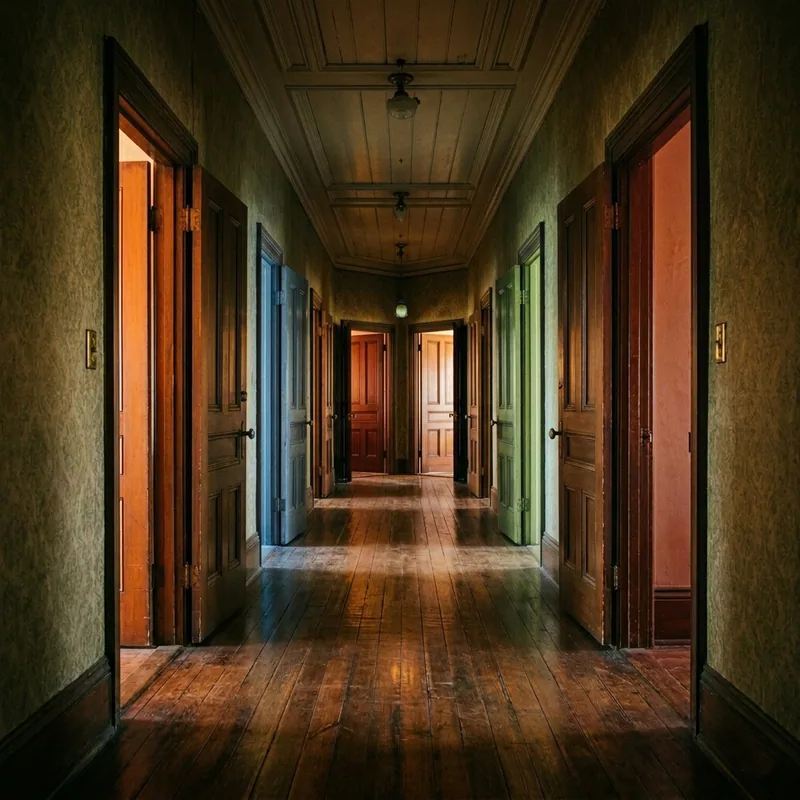
The house in your dream is a map of your psyche. Every room, every floor, every hidden passage represents a different aspect of who you are. What you discover in this house reveals what you are uncovering within yourself.
🧠 Freud's Interpretation
For Freud, the house was a symbol of the human body. Different rooms corresponded to bodily functions and zones. The facade represented how we present ourselves; the interior held what is private. Locked rooms contained repressed desires, and entering forbidden areas symbolised transgression. The condition of the house reflected the dreamer's relationship with their own physicality.
📖 Show source
Freud, S. (1900). The Interpretation of Dreams. Franz Deuticke, Vienna.
🔮 Jung's Interpretation
Jung's most famous dream was about a house with many floors. And it became the foundation of his theory of the psyche's layers. The upper floors represent conscious awareness, the ground floor is everyday personality, and the basement is the personal unconscious. Below that lies the collective unconscious. Ancient, primal, shared by all humanity. Discovering new rooms means discovering unknown aspects of yourself.
📖 Show source
Jung, C. G. (1964). Man and His Symbols. Aldus Books, London.
✨ Spiritual Interpretation
Spiritually, the house represents the soul itself. The dwelling place of your consciousness. A well-maintained house suggests spiritual health; a dilapidated one calls attention to neglected inner work. Many traditions describe the body as the "temple of the soul," and house dreams tap into this ancient metaphor. Each room is a chamber of your being waiting to be explored.
📖 Show sources
Ibn Sirin (8th c.). Tafsir al-Ahlam.
Moss, R. (2009). The Secret History of Dreaming. New World Library.
⚡ Biosynchronous Analysis
House dreams strongly activate the hippocampus and spatial memory. Place cells create an internal map. The house in the dream represents psychic architecture: known rooms reflect conscious aspects, unknown rooms represent repressed ones.
📖 Show sources
Hall, C. S. & Van de Castle, R. L. (1966). The Content Analysis of Dreams. Appleton. · Domhoff, G. W. (2003). The Scientific Study of Dreams. APA.
📊 From the Ethyria Community
Most Common Companion Symbols
 Being Chased (19 %)
 Being Naked (16 %)
 Snakes (13 %)
 Ex-Partner (11 %)
🔄 Common Variations
Discovering hidden rooms
Uncovering unknown talents, memories, or aspects of yourself. Expansion of self-awareness.
Renovating a house
Active self-improvement. You are consciously working on transforming aspects of your personality.
 Spiders
Going down to the basement
Descending into the unconscious. You are brave enough to confront what lies beneath the surface.
 Water & Ocean
Childhood home
Connecting with your origins, early experiences, and foundational patterns that still shape who you are.
 Falling
 Death & Dying