Dream Meaning:House & Rooms
Based on global search queries (Google Trends, 2025)
Dream Interpretation by Freud
Freud interpreted the house as a symbol for the body itself, with the different rooms embodying different body zones and organ functions. Libidinous energy flows in these dream images between the floors and shows where drive-related impulses accumulate or are warded off. The strict upper floor represents the superego with its commandments, while the dark basement harbors repressed desires.
Locked doors and hidden chambers point to infantile symbolism, to early, childfully occupied ideas of nudity, the forbidden and one's own body. The variants of the house thus provide information about which drive conflicts are currently unconquered.
Show source
Freud, S. (1900). The Interpretation of Dreams. Franz Deuticke, Vienna.
Dream Interpretation by Jung
For Jung, the house was the guiding image of the stratified psyche, as he himself experienced it in his famous dream of a multi-story house. The upper floor stands for consciousness and the habitual personality, the deeper floors for the personal and beneath it the collective unconscious with its archetypes.
Those who discover new rooms approach the self and gain a higher perspective on their life. The shadow is also touched, that part of the unconscious that we do not recognize as belonging to us. The childhood house in the dream leads back to the original source of one's own biography.
Show source
Jung, C. G. (1964). Man and His Symbols. Doubleday, New York.
Spiritual Interpretation
In many cultures, the house is considered an image of the soul itself and as a dwelling place of the higher self. Shamanic and esoteric traditions often interpret the roaming through rooms as astral travel, in which consciousness leaves the body and explores other planes.
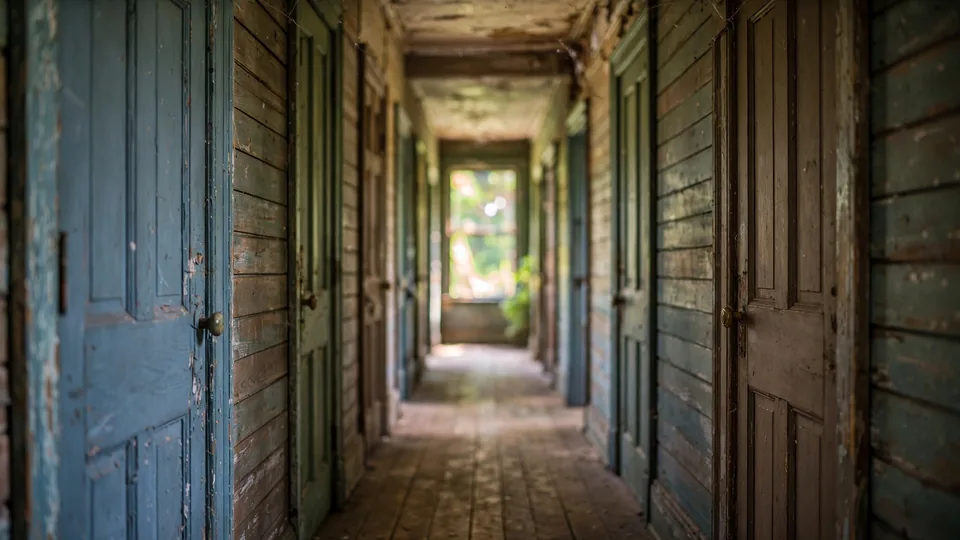
A bright, orderly house speaks for a balanced inner life, a dilapidated house for neglected spiritual work. The discovery of previously unknown rooms is understood interculturally as an expansion of consciousness and the discovery of new gifts. So the mere building becomes a temple of one's own development.
Show source
Bulkeley, K. (2016). Big Dreams. Oxford University Press. Fromm, E. (1951). The Forgotten Language. Rinehart & Company, New York.
Cognitive Continuity
Domhoff understands house and room dreams as a metaphor for one's own psyche and the confrontation with different areas of life. Unknown rooms point to undiscovered potentials or repressed aspects.
Show source
Domhoff, G.W. (2003). The Scientific Study of Dreams. APA. Domhoff, G.W. (2018). The Emergence of Dreaming. Oxford University Press.
Neurobiology & Emotion
Walker interprets room dreams as cognitive cartography of one's own psyche. REM sleep organizes spatial and emotional memories, with rooms standing for different areas of life.
Show source
Walker, M. (2017). Why We Sleep. Scribner. Walker, M.P. & van der Helm, E. (2009). Overnight therapy? The role of sleep in emotional brain processing. Psychological Bulletin, 135(5), 731-748.
Common Variations
Visiting childhood house
Return to primal themes and unresolved childhood experiences
Frequently Asked Questions
Analyze your dream now with Ethyria
5 analysis perspectives. AI-powered. Private and encrypted. Your dream journal with meaning.