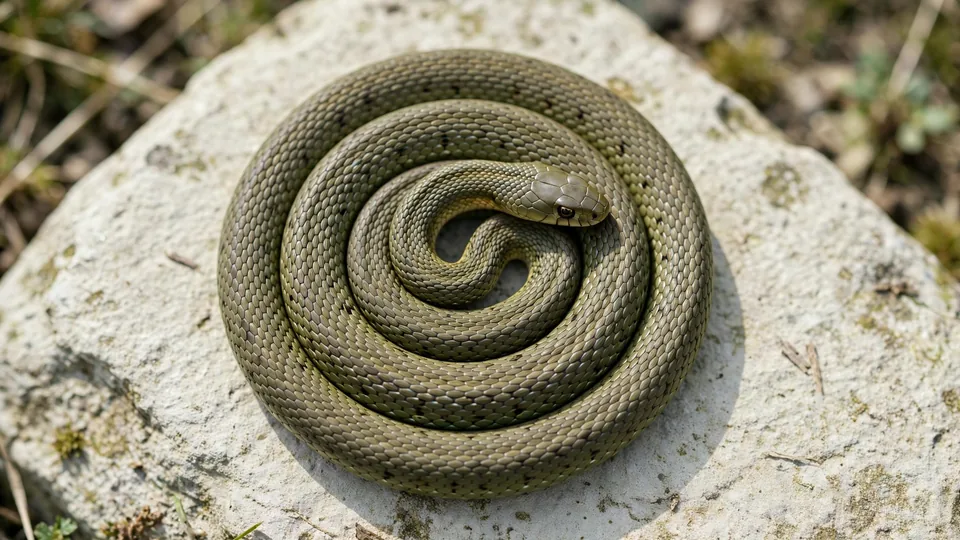
Dream Meaning:Snakes
Based on global search queries (Google Trends, 2025)
Dream Interpretation by Freud
For Freud, the snake is the classic phallic symbol and stands for the libidinous, meaning sexual drive force of humans. It points to desires that the superego has repressed as forbidden and that return in displaced form in the dream.
He often interpreted the snake bite as fear of sexual overwhelm or as punishment for forbidden desire. Variants such as the flickering or coiling snake read for him as infantile, unbridled sexual symbolism. Ultimately, the snake dream shows the unresolvable conflict between the desiring id and the censoring instance of the conscience.
Show source
Freud, S. (1900). The Interpretation of Dreams. Franz Deuticke, Vienna.
Dream Interpretation by Jung
Jung understands the snake as an archetype of transformation, embodying through molting the eternal cycle of death and becoming. It is a messenger of the collective unconscious and leads the dreamer to those deeper layers of the psyche where the self takes form.
From this higher perspective, it is not merely danger but a necessary companion on the path to individuation. Especially when it coils or bites, it touches the shadow: that denied part of the personality that wants to be integrated. The snake is thus simultaneously the threatening and the healing.
Show source
Jung, C. G. (1964). Man and His Symbols. Doubleday, New York.
Spiritual Interpretation
Interculturally, the snake is considered almost everywhere as a sacred, boundary-crossing being. In Hinduism it represents the dormant Kundalini energy at the base of the spine, in Christianity it appears as temptation, in the staff of Asclepius as a sign of healing.
Many spiritual traditions interpret the snake experience in a dream as an indication of astral travel or the awakening of higher states of consciousness. The snake challenges the higher self to shed the old so that new life can emerge. In its wisdom, it is a teacher of transformation and the art of letting go.
Show source
Bulkeley, K. (2016). Big Dreams. Oxford University Press. Fromm, E. (1951). The Forgotten Language. Rinehart & Company, New York.
Cognitive Continuity
Domhoff interprets snake dreams as an expression of mistrust, threat or unresolved interpersonal conflicts. The regional frequency correlates with real encounters and cultural influences.
Show source
Domhoff, G.W. (2003). The Scientific Study of Dreams. APA. Domhoff, G.W. (2018). The Emergence of Dreaming. Oxford University Press.
Neurobiology & Emotion
Walker describes how REM sleep activates archaic threat networks. Snake dreams are the cognitive interpretation of these evolutionary alarm systems, combined with cultural and personal associations.
Show source
Walker, M. (2017). Why We Sleep. Scribner. Walker, M.P. & van der Helm, E. (2009). Overnight therapy? The role of sleep in emotional brain processing. Psychological Bulletin, 135(5), 731-748.
Common Variations
Frequently Asked Questions
Analyze your dream now with Ethyria
5 analysis perspectives. AI-powered. Private and encrypted. Your dream journal with meaning.