
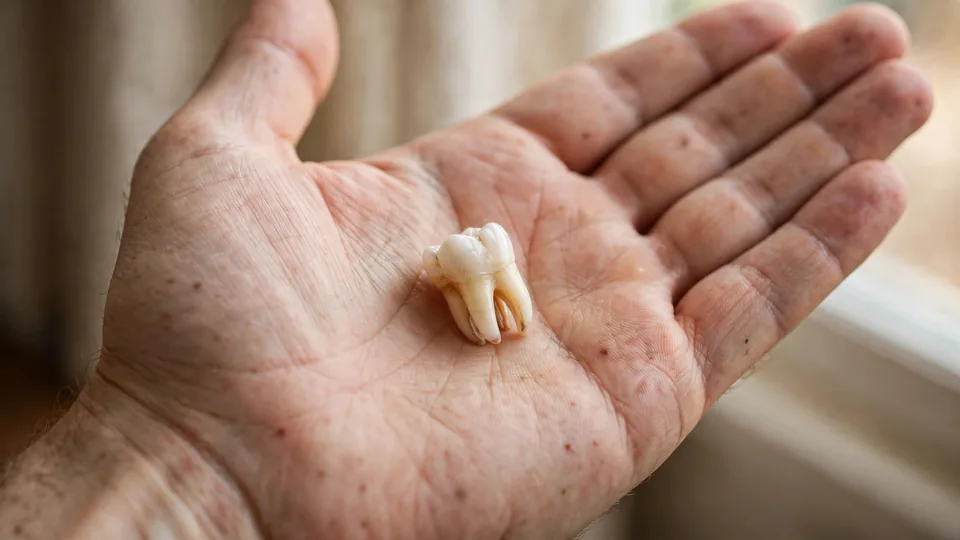
Dream Meaning:Losing Teeth
Based on global search queries (Google Trends, 2025)
Dream Interpretation by Freud
Freud classified the tooth loss dream under castration anxiety, the unconscious fear of loss of potency, virility and social standing. The tooth functions for him as a phallic symbol, whose falling out condenses the terror of impotence and aging.
At the same time, he interpreted such dreams as an expression of repressed aggression, for instance when the dreamer wishes to knock out an opponent's teeth and turns this force back upon themselves. The oral stage of childhood development also resonates when biting and chewing return as early desire. In this reading, the dream is a battleground between sexual self-confidence and the fear of its destruction.
Show source
Freud, S. (1900). The Interpretation of Dreams. Franz Deuticke, Vienna.
Dream Interpretation by Jung
Jung viewed the loss of teeth as an expression of necessary change, in which the crumbling facade of the old self makes way for a new form. The child's tooth change provides the archetype: what falls out was only a provisional form anyway, and the new is already pressing through.
In analysis, the dream often appeared to him as an indication that outdated beliefs, roles or relationships must be released so that the personality can continue to mature. The broken mask outwardly corresponds to an inner rebirth that is painful but healing. Those who take this dream seriously encounter an invitation to transformation rather than mere threat.
Show source
Jung, C. G. (1964). Man and His Symbols. Doubleday, New York.
Spiritual Interpretation
In numerous spiritual and religious traditions, teeth are considered instruments of truth because they shape and reinforce the speaking of words. Losing them, according to this view, means releasing old identity and false self-presentation to cleanse oneself of unnecessary burden.
The mouth becomes the place where one meets oneself honestly, and the absence of teeth marks a phase of purification in which silence can be healing. Islamic dream interpreters, for instance, interpret tooth loss depending on person and context as changes in family, health or way of life. What all currents have in common is that the dream is read as purification and preparation for a more truthful existence.
Show source
Bulkeley, K. (2016). Big Dreams. Oxford University Press. Fromm, E. (1951). The Forgotten Language. Rinehart & Company, New York.
Cognitive Continuity
According to Domhoff, tooth loss dreams reflect everyday stress and concern about one's own appearance. They correlate with professional pressure, social anxiety and the feeling of loss of control in waking life (Domhoff, 2018).
Show source
Domhoff, G.W. (2003). The Scientific Study of Dreams. APA. Domhoff, G.W. (2018). The Emergence of Dreaming. Oxford University Press.
Neurobiology & Emotion
According to Walker, tooth loss correlates with nocturnal bruxism under stress. REM sleep processes the emotional burden while the body releases tension through teeth grinding. The dream figure is a metaphorical translation of physical stress response.
Show source
Walker, M. (2017). Why We Sleep. Scribner. Walker, M.P. & van der Helm, E. (2009). Overnight therapy? The role of sleep in emotional brain processing. Psychological Bulletin, 135(5), 731-748.
Common Variations
Frequently Asked Questions
Analyze your dream now with Ethyria
5 analysis perspectives. AI-powered. Private and encrypted. Your dream journal with meaning.