Understanding Nightmares: Meaning, Common Motifs and What Really Helps
A nightmare wakes you up. Your heart is racing, the story is still there, and the question remains: what was that? Nightmares are part of normal sleep, they are not a warning sign and not madness. Here is what research knows about them, which motifs appear most often and what measurably helps.
What is a Nightmare?
Definition: A nightmare is an intense, unpleasant dream that wakes you from sleep. It mostly arises in REM sleep, the dreaming sleep of the early morning hours, which is why the fear is still fully there when you wake: the scenery, the feelings and the story can be remembered exactly.
The difference from a bad dream: A dream that merely goes badly stays halfway and is remembered in the morning as grey or blurry. A nightmare wakes you, and the waking is the feature that separates it. The story is interrupted, not resolved, and that is exactly why it sticks.
Related: Dream Interpretation Methods · Dream Symbols and Their Meaning
Nightmares in Numbers: How Normal They Are
85 percent of adults report at least one nightmare a year. Nightmares are therefore no exception but a regular part of sleep. What established sources measure here is something everyone who startles awake at night shares with millions of others.
2 to 5 percent of adults have a nightmare disorder, the recurring, distressing form. The gap between 85 and 5 is the real message: the single nightmare is normal, the disorder is rare.
A Korean population study with 2,824 people shows how the burden changes with age: 13.4 percent reported nightmares more than once a year, 2.6 percent met the criteria of a nightmare disorder. Spread across age groups it is unequal: between 50 and 70 the disorder stood at 1.8 percent, over 70 at 6.3 percent.
The Most Common Nightmare Motifs
Nightmare motifs are not random images. They sort what creates pressure in waking life: losing control, the pressure of being pursued, the fear of the crash, loss. Three motifs appear most often across all studies:
Being chased is the most common nightmare motif of all. The pursuer is usually not a stranger but a part of your own inner self that you avoid in everyday life: Being chased in dreams: meaning and interpretation
Falling connects the moment of startling awake with the fear of the crash, of failing an expectation. The fall is rarely the end, it is the beginning of the reading: Falling in dreams: meaning and interpretation
Death in a dream is not a prediction dream but a threshold of transition: the end of a phase, a relationship, a self-definition: Death in dreams: meaning and interpretation
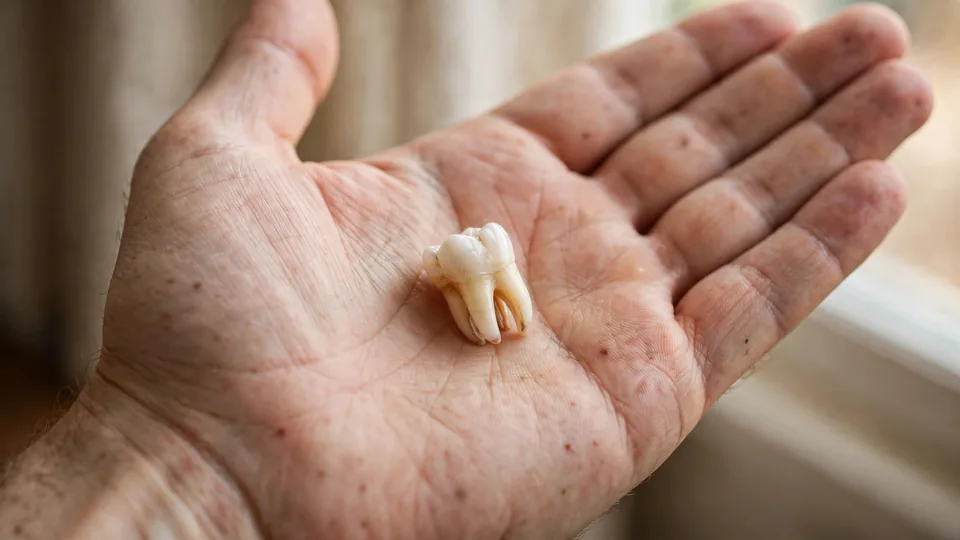
Three more frequent night motifs come with their own reading pages: Spiders for intrusive stress, Car accident for speed out of control and Losing teeth for feelings of loss and self-image. All 99 motifs are in the dream symbol lexicon.
What Really Helps: The Evidenced Method
Imagery rehearsal, the best evidenced method: After a nightmare you write it down and then rewrite its ending: not the fear, the ending. Instead of waking up you protect yourself inside the image, you fend off, you land somewhere else. You then go through this new version in your mind for a few minutes, ideally daily, over several days. An evaluation from 2021 reports around 64 percent fewer nightmares after a single session. The rule along the way: fear is never amplified. The exercise builds no threat, it rewrites the ending.
The dream journal: Those who write nightmares down see the patterns after a short time: the same places, the same people, the same feelings. Scientific evaluations of around 20 studies measure writing as a small to medium effect for psychological distress. It sorts instead of puzzles, and it is the foundation for every imagery exercise.
Sleep itself: Fixed wake-up times, also on weekends. Alcohol and late screens push the dreaming sleep and with it the nightmares. Better sleep means fewer wild dreams, that is no call for perfection, it is the base on which the exercise works.
When It Is a Nightmare Disorder
The boundary is clear: A nightmare disorder is present when the dreams recur, wake you several times a week and the day suffers. According to the literature it affects 2 to 5 percent of adults. Those who know the boundary can test it instead of guessing.
Shame is the wall: Many people carry nightmares around for years because they do not dare to speak about them. Yet the nightmare disorder is treatable, and imagery rehearsal is part of treatment, no miracle method. A conversation with a doctor or psychotherapist is the path that moves measurable things.
Ethyria's boundary: The app does not diagnose and does not replace treatment. It brings order: making patterns visible, naming repetitions, providing context. Anyone who notices that a pattern burdens rather than merely surprises already has an honest answer to bring to a conversation.
Nightmares and Lucid Dreams
Both run in the same dreaming sleep and differ in one question: who is awake? In a nightmare the story steers, in a lucid dream the dreamer knows it is a dream and can intervene. That is exactly why the training overlaps: those who know their own dream signs also recognise them in a nightmare and can become clear there instead of fleeing.
The way there is the same as for lucid dreams: dream journal, know your dream signs, stabilisation. Everything that helps is on the sister page: Lucid Dreaming: The Complete Guide
The way into practice: Ethyria reads every dream text from five psychological perspectives, makes recurring patterns visible and connects the analysis with your sleep cycle. The dream text is processed encrypted and shared with no one, not even third parties. Anyone who wants to enter a nightmare needs no fear of judgement: there is none.
From the Ethyria Community
Based on 874 dream interpretations · most common themes: Loss of Control & Change.
Frequently Asked Questions About Nightmares
Further Reading
References
Understand your nightmare instead of fearing it
5 analysis perspectives. Encrypted processing. Nothing goes to third parties. Free.